Thursday, 17 May 2012

Henri Rudert-Restoration progress


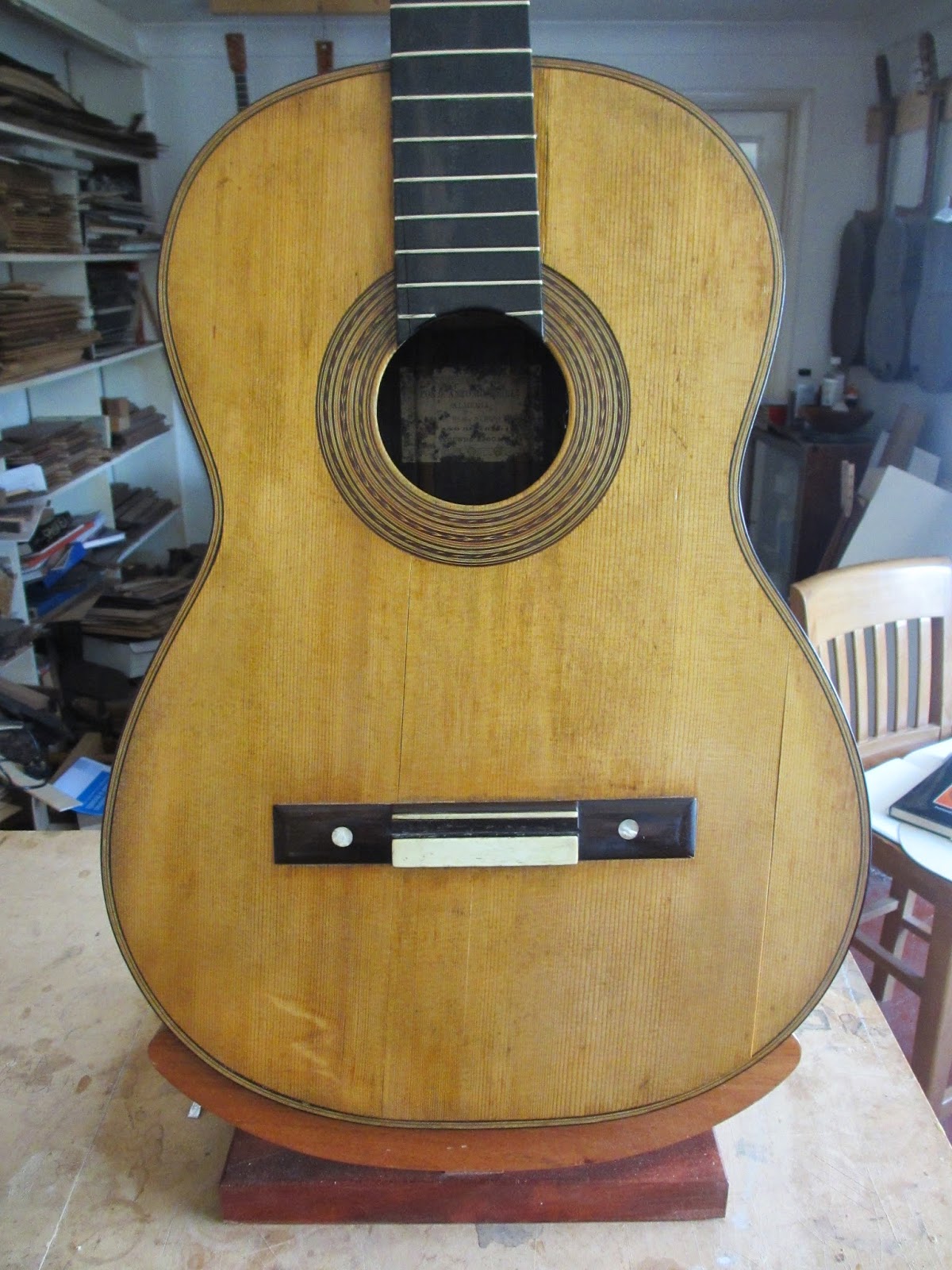
Here are some details of of the Henri Rudert that I took in recently. It really is the most lavishly decorated guitar; the workmanship is some of the finest I have seen. Like many guitars, it has suffered damage over the years, most of it due to humidity changes. The main area of restoration on this instrument is focused on the back, which has split from end to end. (see here)


The back is constructed like many guitars from the 19th century; spruce veneered with a decorative hardwood, in this case flamed maple. This type of construction allowed for a more economical use of precious and beautiful woods but over time the tensions in the back have caused it to split. Not only has it split; it has also curled up on either side of the split, as can be seen in the picture above.
I removed the back without using heat or water as the old glue was pretty degraded and came apart quite easily. I was pleased not to be using water as the delicate banding around the edge of the ribs is very delicate. Once the back was off the one remaining attached bar was removed, as was the label. The label was in two halves as the back had split through the middle of it. The back was then completely separated and ready for careful rejoining.


The curl in the back was removed by gently heating, followed by prolonged clamping. The split had at some point in the past been filled by a crude mastic, or filler and this had to be painstakingly picked away by hand. Very often the most time consuming part of restoration work is correcting or reversing previous repair work and removing this hard filler was a slow job that I completed over a number of days. Once the old filler had been removed I had to decide how far to go in rejoining the back. Ideally I would get a perfect match but the distortion of the wood over time prevented this. Also, the split is not straight edged, but is tightly waved, following the flame of the maple.

The picture below shows the back bars after they have been reattached to the back. The waist bars awaits fitting and reglueing, The split in the spruce will be restored once the back has been fully stabilised by the addition of the last back bar. The clamps are holding the delicate ends of the back until these can be reinforced.


And finally, the picture below, shows the signature and date found pencilled on the inside of the guitar when the back was removed. I am used to seeing these and other marks in old guitars, but I was very pleased to fine this one, especially as it gave a precise date. It also captured a brief moment in time, when a guitar maker, busy in his workshop, signed and dated his work, just as I do now.


Friday, 4 May 2012

A recently finished guitar


This 2012 spruce and rosewood guitar left the workshop yesterday. I frequently get asked if I mind letting them go, and the simple answer is no. As a professional maker, I need to sell my work to continue what I am doing, and so finishing a guitar, receiving payment and dispatching it to its new owner is a natural and regular part of what I do. I also find that I constantly think of the next instrument I am to make; by the time a guitar is polished and strung, my involvement is over and it is time for the player to nurture the guitar and realise its potential. My mind is on future instruments; how I can build upon successes and carry my ideas forward.

This guitar was one I was particularly pleased with, and I spent a quiet hour with it yesterday looking, playing and measuring it, trying to absorb everything about it and what I should strive to replicate in future guitars.


Friday, 27 April 2012

French guitar restoration part 1


This guitar came in a few weeks ago and has given me considerable pleasure to work on. It was clear, as soon as the case was opened, that the guitar had been considerably altered as is so often the case with vintage guitars. At some point the headstock had been broken off, and had been replaced by a rather inappropriate substitute, complete with unusually mounted modern tuners. The bridge had pulled away and had been replaced by a modern classical guitar bridge which, in turn, had failed. A new fingerboard had also been fitted but, just visible on the soundboard, were the ebony fret inserts that showed this guitar originally had a flush fingerboard. (See the photograph below.)


At some point in the past, I was told, the guitar had been taken out to Libya (there is an evocative luggage label from Tripoli on the case) and the hot, dry desert air had caused the guitar to dry out, resulting in some large splits in the top and back.

It was decided that I should take the restoration as far as I deemed appropriate, but that it should certainly be restored to a playing condition. This guitar has had many different incarnations and has been repaired and adapted according to circumstances. At this stage, I feel that the most appropriate course of action is to restore it, as near as possible, to its original state.


My first task was to try and close the top and back splits by re-hydrating the guitar. In theory, subjecting a guitar to a moist environment should swell the timber and close the cracks. However, sometimes other distortions and tensions prevent this from happening. As I write this, the splits have lessened but not closed completely.


It was only after the guitar had been in the workshop a few days that a close inspection of the interior revealed a very indistinct makers stamp, located on the upper treble side lining at the waist. Although unclear, the stamp is that of F. Roudhloff, a well known French maker from Mirecourt. Francois was the brother of Charles Roudhloff (and not the son, as sometimes believed) and uncle of Dominic and Arnould Roudhloff, who also made guitars.

I removed the old headstock and made a new figure of 8 head, based on that of the C.Roudhloff instrument. The pictures below show part of that process. A v-joint takes either 5 minutes or 5 hours to fit; this one took me 5 hours!


As can be seen from the picture below, the neck is veneered with fine, black ebony on a core of sycamore or possibly lime. The new head is sycamore and will be ebonised at the end of the restoration.


By some considerable coincidence, this week has seen a guitar by Charles Roudhloff in the workshop, so the temptation to photograph the two brothers' guitars together proved to much. The Charles Roudhloff, on the right, is a more ornate guitar with a moustachioed bridge and decorative binding.


Thursday, 19 April 2012

Guitars in.....and out


The past couple of weeks have been extremely busy but highly enjoyable.
Firstly, a couple of fine 19th century guitars have been brought in, the most spectacular of which is a Henri Rudert which boasts some very flamboyant decoration. By modern standards this may seem somewhat florid and ornate, but I cannot help admiring the skilful execution of the work. The main work to be undertaken on this guitar is to repair the dramatic back split that runs from end to end of the body. The headstock (shown below) requires a little work, as does the soundboard.


I have also taken in a French guitar which is in need of substantial work to restore it to original condition. It can be seen in the picture below, furthest from the camera.

Those are the guitars that have come in, but I also have three new guitars leaving the workshop in the next week or so. I haven't had time to feature them on the blog, but they are guitars I am very pleased with and I hope their new owners are too. One of these guitars is seen on the workbench for final adjustments and polishing. Hiscox cases arrived earlier on in the week so these guitars are nearly ready to go.


Thursday, 5 April 2012

The wood so wild - an Eastertide trip to David Dyke


I have mentioned David Dyke on this blog before, and I am sure that no UK instrument maker will be unfamiliar with his name. David has been one of the most prominent and respected instrument making suppliers for many years. David started by teaching guitar making in the 1970's before moving into timber supply, and since then his luthier supply business, based in Horam, East Sussex, has become established in many guitar makers address book. I remember visiting David for the first time in 1984 when I was in my first year at the London College of Furniture. I bought a set of Indian rosewood, some Brazilian mahogany and a set of flamed maple, and was enthralled by the sight of all the timbers, strips of inlay, racks of machine heads and coils of fretwire.


This week was the first week of the Easter holidays and so I combined a trip to David's with a family picnic as the children were not at school. I had a few bits and pieces to pick up, most notably some 1.6 fretwire for my Ries copy, but David was also cutting some rosewood blocks for me and I wanted to see it done. David uses a large circular saw for this job and, although it turns more of the wood to dust compared to a bandsaw, it leaves the timber with a very fine finish.


Business at David Dyke's isn't a slick, high-tech affair, but enjoyably laid-back. As I walked in Mike Reid was busy cajoling everyone into signing up to a children's charity competition (hopefully I will win a cuddly toy panda) and David himself was out the back having a brew in one of his sheds. Discussing instrument making with Mike is always fun; Mike has his own business, Small Wonder Music, specialising in inlay products.


Eventually David powered up his saw and sliced into the blocks of rosewood I had. These were the last remnants of a huge piece that I acquired many years ago. These last blocks were only good for 4 piece backs- jet black with a few pink streaks - and a few fingerboards which I swapped for a couple of sets of English yew. The size of the saw can be seen in the picture above, and the large stack of timber in the foreground is some African ebony that David had just sawn for backs and ribs.


The yard is not the most ordered in the world, but is all the more interesting for that, and David seems to know were everything is. Some new racks were being built when I visited this time, just visible at the end of the shed. I was taken with this violin template below, hanging on the peeled-paint door of the shed.


This area of East Sussex is one of narrow lanes, hedgerows and quiet woods. The beautiful river Cuckmere winds its way gently to meet the sea at the majestic Cuckmere Haven, and the dark line of the South Downs can often be seen.

We stopped for our picnic at Arlington and watched the first swallows of spring dipping over the water. The wild oak took my eye, its bare branches in contrast to the green exuberance of the hazel and hawthorn behind.


Saturday, 10 March 2012

A week in the workshop (Friday)


Julio came today to pick up his new guitar. I had been delayed with this as the polish wasn't quite to my satisfaction and Julio had been very patient. Most guitar makers fret and worry about their finish; it is one of those things that can haunt you. In the case of this guitar, I kept getting a couple of thin patches on one rib, possibly exacerbated by a particularly oily patch in the rosewood. Anyway, eventually it was complete and polished.

Julio successfully dodged the traffic on the M25 and seemed very pleased with the guitar. I had provided 3 saddles with this instrument, offering different action options and Julio seemed very much at home from the start. I wish them both many happy years together!

Friday, 9 March 2012

A week in the workshop (Thursday)


I had been planning on driving over to David Dyke's today to get some sawing done (some blocks of rosewood that I have been meaning to have cut for some time) but reluctantly I opted to stay in the workshop and finish off a few loose ends. Julio is due to pick up his guitar on Friday and I am keen to do some final adjustments and to complete the paperwork for the instrument.

Yesterday the tuners for this guitar developed a fault and I spent a few frantic hours procuring a new set (thank you Michael and David) and this put me behind with other work. I had been particularly keen to strip the top of the Ken Roberts guitar that came in a few weeks ago. The repair on the split in the soundboard has been completely successful and I now want to complete the re-polish so I can return it to its owner. The picture above shows the old French polish being softened and removed.

I have also been preparing some rosette blocks. This is a fun part of guitar making and the whole process seems quite miraculous. The strips below have not been glued but are held together with a peg to check the alignment. I'm glad I did this- looking closely at the photograph I realised I had left a strip out of the pattern.