Saturday, 26 November 2011

Adam's guitar-bindings


Here are a few pictures of the guitar I am making for Adam when it was being bound. I have chosen flamed koa for the bindings; I love the rich colour against the dark Indian rosewood and the rippled figure in the wood is a delight. The humble clothes peg makes a wonderful clamp as the above picture shows. This is a rather laborious way of making up bindings but the finished effect is well worth it.


I know I have shown a similar picture to this before but I couldn't resist adding another one. I much prefer using cloth tape to hold the binding in place whilst gluing as I can apply a lot of all round pressure using this method. Visitors to the workshop who witness this process are most intrigued by the sight of a trussed up guitar. I remember one rather shocked visitor voicing concerns that she had stumbled on some bizarre ceremonial guitar making ritual. It took some time to convince her that it was an everyday guitar making practice.


And finally, the finished purfling and binding. The koa will come alive under the polish and provide an elegant but understated edge to the guitar. Koa is a beautiful timber from Hawaii and has been used for ukuleles and steel string guitars for many years. When I started making guitars it was very rare to see it in the UK, but the internet has made this special timber readily available to makers. I love it and feel privileged to use it in my guitars.

Tuesday, 8 November 2011

In the workshop-Adams guitar


I have been meaning to post these pictures for some time now, but working out how to use the new camera and keeping up with tasks in the workshop has prevented me from doing so. These pictures are of Adam's guitar, which has a Western red cedar soundboard and Indian rosewood back and ribs. These pictures were taken some time ago; the guitar will be ready for polishing by the end of this week. The rosette is a simple but elegant one. It harks back to Torres, but its strong simplicity has a very contemporary feel to it. I make my rosettes in a jig and then inlay them whole into the soundboard. The cut you can see in the rosette allows for easier fitting and is completely hidden under the fingerboard once the instrument is complete.


Here is a picture of the finished soundboard and the back behind it. I still use a fairly traditional strutting pattern and many familiar elements can be seen in my strutting. One of my main interests at the moment is adjusting the positioning of the 3 lower bout cross bars in relation to the soundboard qualities. The positioning of the bar directly beneath the bridge is particularly crucial. I am conducting experiments on my test bed guitar to nail this down more precisely. I have been using this pattern for about 5 years and it gives me the beauty of sound that I love, with a power and dynamic range which many contemporary players require.


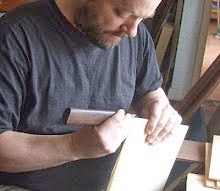
Here is a rare action shot! I do not use a full form to build the guitar, which I find cumbersome to use. I have a base board with a small number of locating dowels that hold the ribs in place whilst the end blocks are glued in. In this picture I am cutting the notches in the linings into which the back bars will fit. Those of you who know me well will gasp the at appearance of glasses. Years of close work have caught up with me so I now have this new bit of crucial workshop equipment.


This picture shows the linings and end block. It also shows the laminated rib construction that I use on most of my guitars. The end block is given a few coats of shellac for no other reason than I like the look of it through the soundhole. With the notches cut I am now ready to finally fit and glue the back, before moving on to the top linings and soundboard fitting.

Thursday, 3 November 2011

Walnut guitars


A couple of guitars have recently been finished in the workshop that have used walnut for the back and sides. Neither have been made by me; they are the work of Lawrence (above) and Frank. Lawrence has recently relocated to Australia and we finished his guitar with a week or two to spare before he left. The guitar worked out beautifully; spruce, black walnut and a maple neck, with an elegant African blackwood soundhole inlay. I do hope this has survived the journey out to Australia.

Frank's guitar has a rather more complicated story. Having already completed a fabulous Macassar ebony 6 string, Frank decided to build on that success by following up with a 12 string using maple and walnut for the back and ribs. I can't quite remember all the twists and turns of this project, but it started as a large bodied 12 string, and ended up as a very fine 6 string tenor guitar. Just the middle courses are doubled.


This picture shows Frank's fine workmanship and the elegant rosewood bridge. Below is the instrument about five minutes after being strung up for the very first time. This is always an exciting moment for any maker, marking the culmination of many hours of work. Frank had come straight from work, hence the smart shirt!


Thursday, 13 October 2011

Louis Panormo copy


Rebuilding this copy of a Panormo guitar is a project that I have been working on for the past year, when I have had an occasional bit of spare time in the workshop. It is something that I have been meaning to do for years but it has always got pushed to the bottom of the list.
I originally built this guitar in 1991 as a way of learning more about the guitars of Louis Panormo, and to extend my repertoire as a guitar maker. Having completed the guitar and proudly strung it up for the first time, I quickly lent it to a player for some concerts. Sadly, he almost immediately dropped it and it was returned to me with the soundboard irreparably damaged. Having put all that work into building the guitar only to see it smashed ensured that I didn't have the heart to repair it, and so I put it in a corner and forgot about it. There have been several occasions since then when I have been close to throwing it away, but have never quite managed to do so. I am pleased to say that it close to being strung up again.


Had this been an original Panormo I would have repaired the soundboard, but with this modern replica it was preferable to replace the soundboard. I hadn't been happy with the original soundhole embellishment so this gave me the chance to produce something a bit better. The picture above shows the new soundboard just before I glued it to the body of the instrument.


I'm pleased to say that this 'new' guitar is a considerable improvement on the original instrument I made and I am very much looking forward to stringing it up again. The polishing is complete and the bridge is glued on; I am just waiting for tuners.

I haven't found a new owner for this guitar yet but I hope that this time it will be looked after properly.

(This guitar has now been sold)

Friday, 30 September 2011

friday evening


My main computer comes back tomorrow (the power on button failed - reassuringly low tech stuff) and I will be able to plug the new camera into it. I have been without a camera for a couple of months since I dropped my old one on a hard chalk and flint path on the South Downs.

This is the end of an auspicious week, where the blog achieved more monthly page views than ever before. I have very much enjoyed writing about my workshop and all that goes on in it, and have been thrilled with the interest that has been shown by people from all over the world. It seems to have provided inspiration for some, valuable information for others and an insight into another world for many. Thank you for taking the time to read it.

The picture at the top of this post is an old one and shows linings being glued in.

Thursday, 8 September 2011

Birds-eye-maple guitar


I have recently sent this guitar to Guitar Salon International in Santa Monica and I thought I should post some pictures of it as it is a striking guitar. GSI are one of the leading classical guitar dealers and have rightly established a fine reputation for their knowledge and professionalism. I have been dealing with GSI for many years now (I think since 1998) and it is always a pleasure to work with them. Tim Miklaucic established GSI in the mid 80's and has always had a sumptuous stock of magnificent guitars, both new and vintage. I think it is very telling that GSI's style and ethos has been emulated by others, and their website has set the standard for others to follow. All guitar enthusiasts should take a look at their site which has a huge amount of fabulous pictures, information and recordings.


This particular guitar is my traditional model, and whilst it is not a slavish copy of any particular instrument, it does draw on a couple of Torres guitars that I have worked on (I must write something about those), the 1941 Hauser which I have written about, and the guitars of Simplicio. GSI have been so kind as to describe this guitar as 'an exceptional guitar by all standards' which I am very flattered by.


Friday, 19 August 2011

Yew

A few days ago I had a break from the workshop and spent some time walking through Kingley Vale, the largest ancient yew forest in southern Europe . Amongst the trees there is a grove of majestic, twisted yews that are believed to be around 2000 years old. English yew is a remarkable tree and has become immersed in English folklore.

The wood of the yew is most commonly used for the traditional longbow and I have promised myself that one day I will make one. It is not widely used in guitar making, although I regard it as an English 'exotic' timber that can rival some rosewoods in appearance. It is, of course, a softwood but with an even and smooth texture. Often it shows wild graining and it is difficult getting clear timber big enough for guitar backs and ribs. I use it for small details such as purfling and binding, or for headstock facings, such as the one above.