Thursday, 7 July 2011

trussed and bound

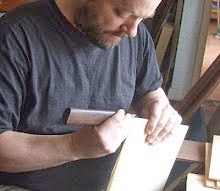
At the beginning of this week I completed the binding on the two guitars that I am building at the moment, including this guitar for Julio. Both these guitars have cocobolo bindings, which is one of my favorite woods for this job. I know I've posted pictures of this operation before but it always makes for a good photograph.
Going back even further are these shots of the back inlay going in. Although I used to make the channel with a scraping chisel, I now prefer to use a router to make this cut. I don't have any problems with using routers (or bandsaws, piller drills etc) to build my instruments. There is a school of thought that says that a hand made guitar should be made using traditional hand tools only, but this is a not a view to which I subscribe.There are guitar making tasks that are made genuinely more efficient by using machinery, and the time saved can be more usefully spent on operations where the precise touch of the makers hand is needed.
This is a picture of the back strip fitted but not glued as yet. You can also see the rather stunning rosewood, which has some lovely colours and a nice tight grain. It is very well quartered too. as can be seen by the medullary ray figure.

Saturday, 25 June 2011

Old School Guitars launch

Recently I attended the launch of Old School Guitars in Eastbourne. This is the new venture of David Crozier, a man who has established a great reputation in the UK and beyond for his knowledge of fine guitars. He has now started this new venture and very good it looks too. David has a passion for all things guitar; he has a fine guitar collection of his own and plays in several local bands. Over the past few years he has added guitar making and repair to this, and has just started building his third instrument in my workshop. David also has a passion for treating his customers with great care and respect - surely the way business should be done.


Tucked away in the old part of Eastbourne, the inside of this mews building, the home of Old School Guitars, is full of examples of the very best steel string and electric guitars. My eye was caught by an Eggle Saluda 'Book of Kells'. Someone else was attracted to it as well as it was sold before I arrived home! The picture above sums it up; David (in the white shirt) enthusing over a Patrick James Eggle guitar, and lots of happy guitar players!

The picture below shows part of David's in-shop work bench. I must have a word with him about this as it really is far too neatly laid out, unlike my own chaotic workbench. Old School Guitars is a delight to see and I wish it every success.

www.oldschoolguitars.co.uk

4

Monday, 20 June 2011

Martin 0-15 - Neck reset


Last night I glued backs on the 2 guitars I am currently building, and today I have been preparing them for binding. The workshop sound system has been pumping out Bob Dylan (and the Carter Family) I don't always listen to classical guitar music you know. It seems appropriate therefore to feature this Martin O-15 which I recently worked on, although I'm not sure that the big Zim ever played one.
This guitar was made in the 50's and was one of the plainest, simplest guitars that Martin ever made. Top, back and ribs of mahogany, no bindings and the simplest of inlays meant that this was an affordable but quality instrument. Like a fair number of old Martins, this was in need of a neck reset, plus a few other small repairs.
The first part of the neck reset process is to loosen the fingerboard where it is attached to the body. I heat the fingerboard( having removed the frets) and then get in under the fingerboard with a hot palette knife. Once the fingerboard has started to separate, I carefully drive a couple of soft spruce wedges underneath and apply a little water and more heat. This can sometimes be the most taxing part of a neck reset, although this one separated without any great bother.
Just for the record, here is a picture of the inside of the guitar which shows the tidy workmanship inside the guitar.
Here is the neck being removed. A 2mm hole is drilled through the 15th fret into the back of the dovetail joint. This allows steam to be driven into the join and so soften the glue. The steam is generated by a domestic coffee maker; the jig and the rubber hose and nozzle are from StewMac. Once the steam has softened the glue, the jig, which puts pressure on the underside of the heel, pushes the neck out of the end block and the neck is removed.
The joint is now cleaned and the shoulders of the heel adjusted to achieve the correct angle on the neck. Because of this adjustment, the joint invariably needs packing with slips of veneer although i have seen a fair few Martins that were factory fitted with shims of card and paper.
1 plastic dot was missing from the 5th fret position so I made another one to fit. It is amazing how long it takes to make a small detail like this, but the end result is worth it. I also patched in some very bad fretboard wear. Some repairers simply fill the hole with epoxy, but I like to let in a perfectly matched piece of rosewood. The picture below is somewhat blurred, but you get the idea.
And here is a shot of the guitar in its finished state, restrung and ready for the next 50 years of music making.


Saturday, 11 June 2011

John's guitar - not the end, but the beginning

I have been featuring a guitar on this blog that I was making for John Mills, the Australian composer. It is now time for the end of my part of the story as the guitar is finally finished, and a few weeks ago John picked the guitar up from the workshop in person. I have really enjoyed building this guitar and the internet has provide a fantastic way of involving John with that building process.
Commissioning a guitar is an act of faith, but then so is building it. As a maker you do your best to build the finest instrument you can and the best you have ever made; there is no point in doing anything else. What you can't always anticipate is the players expectations; the sound they have in their head. Detailed email exchanges with John helped to pin down the sort of instrument that he was after, and there were practical things to be considered such as fingerboard width and neck profiles. John already had his much loved David Rubio guitar, a maker I very much admire, so that provided a good reference point for us both.
Stringing up a new guitar is a moment that still excites me as much as it did when I strung my first guitar many years ago. With this guitar I was immediately pleased and I enjoyed playing it in the weeks before Johns visit. However the first opportunity I had to stand back and hear it was when John played it for the first time. The picture above captures those moments.
John is an accomplished musician and the first thing that struck me when he began to play was the quality of tone he produced; something I always like. To my relief John quickly pronounced that the instrument was to his liking, and we were both relived! Just before John and Pam were due at the workshop, I realised I didn't have any pictures of the finished guitar and although the light was poor, I took a few quick shots for my own records.
A few days ago John called to say that they were all back in Australia and that he was really enjoying the guitar. I hope that continues for many years; thats the beginning of another story.

Thursday, 9 June 2011

Linings and tentelones

I have just returned from a few days away in the West Country with Caroline and the children, and so I am feeling refreshed and pleased to be back in the workshop. I have just joined up a set of satinwood and another set of Malaysian blackwood for a couple of future orders. I mustn't get too distracted by them yet however as I have other guitars to finish first and Julio's guitar is one of them. The picture above shows the inside of the guitar just after the tentelones have been fitted. This is the traditional Spanish method of holding the soundboard onto the ribs. You can see from this picture that I do not use a form for assembling the guitar. I find that a form gets in the way so I would rather not use one. The small blocks around the outside of the top are enough to locate the sides, and using this method obliges the maker to be very accurate with his rib bending and assembly.


Once the tentelones are installed I move onto the linings that join the back onto the ribs. As this is my traditional model I am using a single mahogany strip, but I will very often double this to add stiffness to the bent rib. I have to be absolutely honest here and say that preparing back linings is perhaps my least favorite job on the guitar; I really have to grit my teeth and get on with it. The picture above shows the lining fresh out of the bending machine. The dark residue visible on some of them is rosewood oil from the steel slats of the side bender. The mahogany that I use for linings came from a parcel of boards I picked up from a craftsman who had been using the material for some restoration work that he had undertaken in the historic Brighton Royal Pavilion. I enjoy using timber that has a story attached to it, and I have along personal association with Brighton having grown up there.
So, finally the back linings are in and clamped in place. I love using these little G clamps. The work beautifully and are lovely to hold and work with. With all the internal details complete I can now turn my attention to the back...

Friday, 27 May 2011

Friday evening and I'm shattered. This week has been something of a watershed; various restorations finished, all the timber picked out of the stacks for Adams guitar, paperwork done, dusted and forgotten about and guitars placed in the hands of their new owners.
Finally word came through that Ryan's guitar has arrived safely in South Korea; that's a picture of it above. Ryan had been pipped at the post to a second hand guitar of mine but I was able to provide him with this one from 1987. It was one of the first guitars I made professionally and I used it for exhibitions and demonstrations..... I then lent it to a professional player for concert work, at the end of which it was in a used condition, so I kept it for myself. Intending to have it as my own playing guitar was a fine sentiment but within months I had used the tuners on another guitar and so it has remained unstrung for over 20 years. I'm pleased that it will now be played and enjoyed.
This week I actually heard some live guitar music. Genaro gave me a ticket to hear his friend Edoardo Catemario play in the Brighton festival at St Nicholas Church, the oldest church in Brighton. Edoardo has a fine collection of guitars and on a previous occasion I heard him play on a Simplicio. On this occasion he was playing on a new guitar imported by Paul Gregory. I loved hearing the Suite Espanola by Gaspar Sanz and it was nice to be reacquainted with the Castelnuovo Tedesco Capriccio diabolico which I hadn't heard for years.
Walking through the darkening streets of Brighton after the concert I marvelled at the exotic place that Brighton has become. I have known it all my life, but sometimes it seems like a foreign country, which I think is a good thing.

Saturday, 14 May 2011

buisness as usual

Having been without a usable computer for about a month I can honestly say that it has been a great pleasure not to have one, and I am slightly saddened by the fact that it is now fully serviceable again. Still, it is good to be able to post the odd blog again ( I have had many concerned enquiries about my health) and I have been dealing with a backlog of emails from all four corners.
The workshop has seen a lot of activity however and progress is being made an all fronts. The picture above is of Julio's guitar - the little blocks around the periphery are locating aids for fitting the ribs. I'll be honest and point out that this guitar is rather further on now, but I will save those pictures for a few days time. John's guitar is finished and strung and John is due to pick it up in the next few days; now that is exciting- I hope he is as pleased with the guitar as I am. Repairs have always been there in the background; an endless collection of neck resets and a really satisfying job on Rays hand built guitar. He has just started playing again (its never too late) and it was a pleasure to bring his guitar back to a usable condition.