Showing posts with label Antonio de Torres. Show all posts

Monday, 12 January 2015

1888 Torres SE122 copy (New guitars Part I)


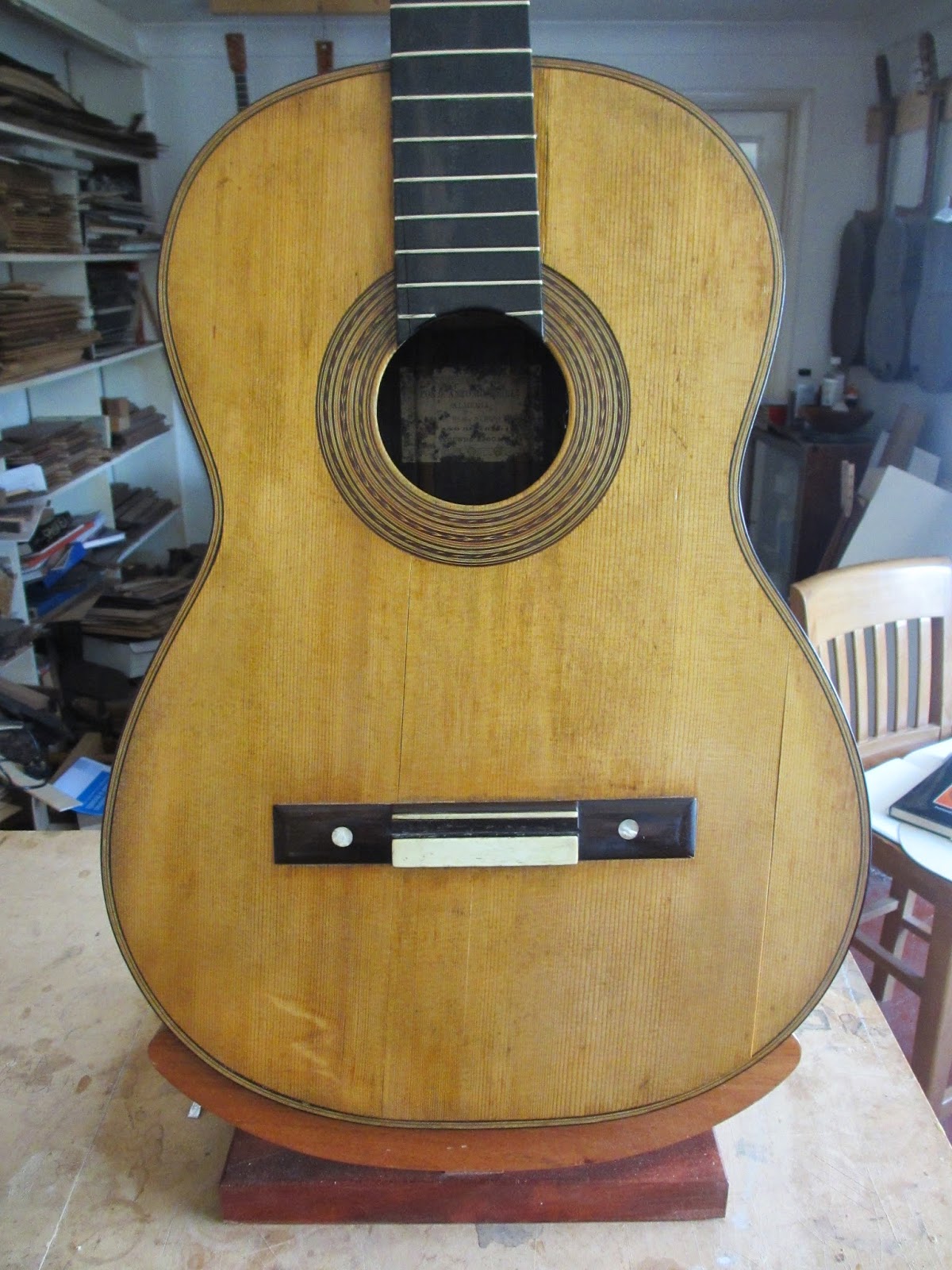
Last week was a busy one, as I was eager to get back in the workshop after the Christmas and New Year break. It was a week for final polishing and stringing up of guitars, the first one being this Torres replica guitar in spruce and rosewood and Cuban mahogany. Last year I measured and drew Antonio Torres SE122; a wonderful guitar that was auctioned at Bromptons (London) in October. This is the first copy I have made of the guitar, and also one of the most faithful replicas I have made of any guitar. The top is an exact copy, even down to the startling grain orientation (the grain lines run 3 degrees off the centre line) and the mixture of rosewood for the back centre strip and sides, with mahogany for the main part of the back.


The original sounded lovely, with a soft, full sound and it responded effortlessly under the fingers. I certainly didn't set out to replicate the sound of an 130 year-old guitar; I wanted to get an idea of what this guitar was like when it was first new; the sounds that Torres first heard when he strung SE122 up in his workshop. The new guitar is crisper, more incisive and more even across the range, but with the same rich depth in the bass and a purity in the treble. I will be fascinated to see this guitar again when it has been played for a few years.

One of the great pleasures in building this guitar was using Cuban mahogany. All the Cuban I have is salvaged from 19th century furniture and it really is fantastic timber with the most glorious rich colour when polished. There is a good supply of old furniture that can be converted into guitars and I enjoy putting it to good use. Sometimes you have to work with nail holes or cuts that were in the original piece, but Torres did the same; there are examples of his guitars that were made from salvaged material with plugged screw holes.


The rosette is an accurate copy of the original, but is fresher in colour. Again, I wanted to make it as it would have looked when new, with bright and vibrant colours. The design is so typical of Torres inlay work and is a strong, sophisticated yet simple statement. The bridge is a little longer than I would use on my own guitars, and longer than on many Torres guitars that I have seen. What caused Torres to do this is unclear, but it seems he did most thing carefully and and deliberately so it is unlikely that it was an accident. Perhaps Torres want to add cross grain stiffness to that particular soundboard (it did seem quite stiff) or perhaps he just liked the look of the longer bridge. The 2 mother of pearl roundels on the wings of the bridge very often look out of place on a more modern guitar but I think, in this case, fit perfectly into Torres's aesthetic.


The tuners I used on this guitar are Rubners with plain brass plates and small round buttons and although different from the originals,I think they suit the guitar well. I currently putting together another copy of this guitar and I am keen to make a comparison.
 I have  had a number of enquiries about the drawing I made of this guitar, and when I get the time I will be making all the information I have available. If you are interested in purchasing a copy please let me know and I will update you when it is published


Thursday, 30 October 2014

Torres SE122 update


Congratulations to all at Bromptons Auctioneers on their highly successful sale on Monday. The guitar by Antonio Torres, SE 122, sold for the hammer price of £85,000. Had I had the money, I would have paid a good deal more for this fabulous guitar. The guitar is special to me in that it is such original condition; and is the closest therefore that many of us will get to Torres himself. Most Torres guitars I have seen have been altered or restored; some significantly. This one is virtually untouched. The new owner I am sure will value and respect this instrument. My hope is that little will be done to change it; in fact I would like to see it remain unrestored.

I was lucky enough to have this guitar to examine in considerable detail earlier this summer and I am in the process of preparing a drawing and detailed description of this guitar for other makers and interested parties to download. I will post details and prices on this blog. I have other drawings of interesting and rare guitars which I will also be making available.

Other guitars that sold on Monday were an interesting Garcia made in 1906, a fairly early guitar by Robert Bouchet, and a nice Lacote 'Legnani' model.

 I am also just finishing my first copy of SE 122 ,(pictured below) and I'm very exited about the prospect of stringing it for the first time. It goes without saying that I will keep you all informed...


Saturday, 3 March 2012

Antonio de Torres FE 18


This is a guitar I see quite regularly and it was in the workshop a few weeks ago for fellow guitar maker Pete Beer to inspect. Torres is of course a special name for all classical guitar makers as his contribution to the development of the instrument was enormous. Torres worked in two periods or epochs and this guitar is from the first epoch and is dated 1864. It is catalogued by Jose Romanillos as FE 18. The body is small by modern standards and is a similar size to a Panormo. It has a 640mm scale length, or thereabouts; it is possible that Torres used imperial measurements, and exhibits many of the features for which Torres is famed.


The rosette is a pleasing example of the decorative work found on some Torres guitars. Torres has made extensive use of dyed green veneer and the fine herring-bone design is one that has been much copied. I have spent many hours making this detail and know how long it takes, and the precision required to do it well.


FE 18 is delightful to play and playing any old and historically important instrument is a moving experience which brings you closer to the history of the guitar. Although the guitar has developed greatly since Torres there is still much to learn from the old makers. It must be remembered that the best guitars are being made now, by living makers and it should surprise no one that this is the case. Makers today have the work of those in the past to draw on, as well as many technologies that were not available to makers in the past.
This guitar can be heard at the Wigmore Hall (London) on the 25th March 2012 as part of a concert given by Edoardo Catemario. A Torres in this beautiful concert venue is a treat indeed.