Wednesday, 13 May 2015

Stauffer 'Legnani' copy


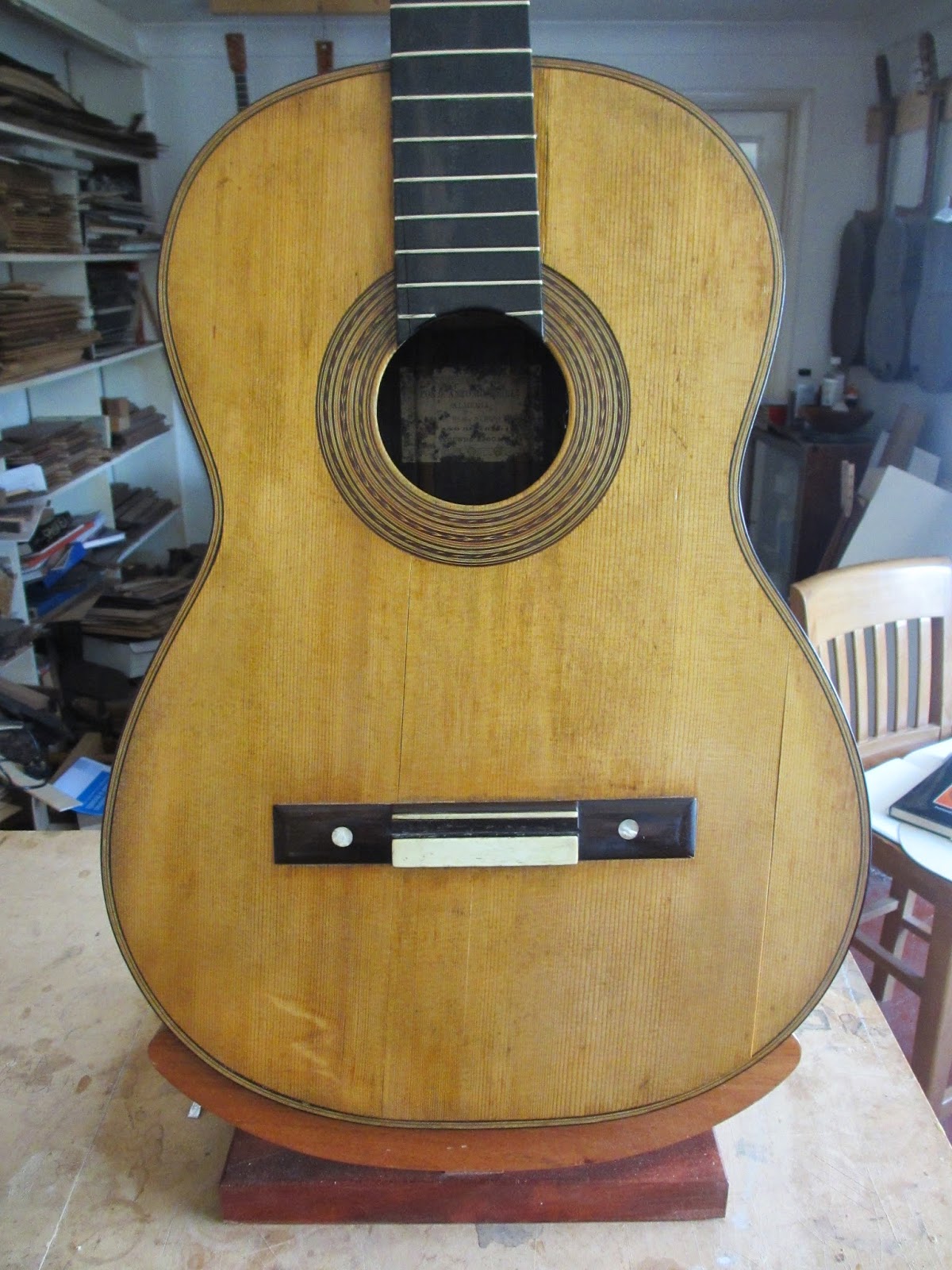
This guitar is a copy of  a J.G. Stauffer from the first half of the 19th century. This guitar, with an adjustable neck, extended floating fingerboard and 6-aside tuners,  was an instrument that Stauffer developed in conjunction with the  virtuoso guitarist  Luigi Legnani.

I've been building this guitar on and off for about 18 months now. It wasn't a commission but one of those projects that has to tick away quietly in some dark corner of the workshop to provide a bit of light relief when building to commission becomes momentarily too stressful. In fact, building something different from the normal guitars I build is a good way of sharpening ones wits, and the unfamiliar subtleties  on an otherwise familiar structure keeps you fresh and inquisitive.I have repaired a number of Stauffer guitars in my career but never made one, and the temptation to build an adjustable neck and use those tuners proved just too big a temptation.


The picture below  shows the Stauffer alongside a partially completed Lacote copy that I made some time ago. The Lacote has a veneered back whilst the Stauffer is solid. All Stauffer guitars I have seen have veneered backs so this was a departure from the original. I chose to build these guitars 'back first' although I am pretty sure that many 19th century guitars were built with the top being fitted first.


The picture below shows the minimalist bracing of the soundboard. The bridge plate is not featured on the original, but is there to protect the underside of the soundboard from string wear and it is unlikely to affect the tonal qualities of the instrument. The 2 supporting cleats are also my additions; they are there to reinforce the soundboard join. Although a departure from the original, I feel the longevity these features might add to the guitar are worth it


 The picture below shows the simple adjustable neck mechanism, supplied by Rubner of Germany. It is a  simple mechanism. Turning the key moves a bolt on a threaded rod anchored in the end block, the tension of the strings pulls the neck forward and thereby increases the the height of the strings. Turn the key the other way and the action is lowered. Guitars with adjustable necks make a lot of sense; a player can set the guitar to his own playing style, set it to match the requirements of a particular piece of music, or correct humidity related changes.


This guitar was made from salvaged Cuban mahogany which I love. It was so old and dry ( cut from a Victorian drawer top) that I wondered if it would cope with the tight bends required for the very waisted Staufer shape. It did thankfully, but my heart was in my mouth for 10 minutes whilst I bent these ribs.


 Above; a detail of the raised fingerboard on this guitar.


 The distinctive 6 aside tuners are made by Rubner. David Rodgers also makes a fabulous replica set which I would use for future orders.
This style of tuner adds weight to the neck and the buttons are quite close together, but this is something you  quickly adapt too. This neck is ebonised using a black french polish.

The final picture below shows the elegant simplicity of this guitar which I love; perhaps I should build all my guitars like this.


Tuesday, 5 May 2015

Concert Guitar (New Guitars Part 2)


This is just a short post to highlight a rather striking guitar I completed and delivered in February. It is an example of my concert guitar with a cedar soundboard and rosewood back and ribs. It is fitted with a rather fine set of Rodgers tuners


I was very pleased with this guitar; cedar can be a really rewarding wood to work with. The back and sides are rather pretty too.....


Monday, 12 January 2015

1888 Torres SE122 copy (New guitars Part I)


Last week was a busy one, as I was eager to get back in the workshop after the Christmas and New Year break. It was a week for final polishing and stringing up of guitars, the first one being this Torres replica guitar in spruce and rosewood and Cuban mahogany. Last year I measured and drew Antonio Torres SE122; a wonderful guitar that was auctioned at Bromptons (London) in October. This is the first copy I have made of the guitar, and also one of the most faithful replicas I have made of any guitar. The top is an exact copy, even down to the startling grain orientation (the grain lines run 3 degrees off the centre line) and the mixture of rosewood for the back centre strip and sides, with mahogany for the main part of the back.


The original sounded lovely, with a soft, full sound and it responded effortlessly under the fingers. I certainly didn't set out to replicate the sound of an 130 year-old guitar; I wanted to get an idea of what this guitar was like when it was first new; the sounds that Torres first heard when he strung SE122 up in his workshop. The new guitar is crisper, more incisive and more even across the range, but with the same rich depth in the bass and a purity in the treble. I will be fascinated to see this guitar again when it has been played for a few years.

One of the great pleasures in building this guitar was using Cuban mahogany. All the Cuban I have is salvaged from 19th century furniture and it really is fantastic timber with the most glorious rich colour when polished. There is a good supply of old furniture that can be converted into guitars and I enjoy putting it to good use. Sometimes you have to work with nail holes or cuts that were in the original piece, but Torres did the same; there are examples of his guitars that were made from salvaged material with plugged screw holes.


The rosette is an accurate copy of the original, but is fresher in colour. Again, I wanted to make it as it would have looked when new, with bright and vibrant colours. The design is so typical of Torres inlay work and is a strong, sophisticated yet simple statement. The bridge is a little longer than I would use on my own guitars, and longer than on many Torres guitars that I have seen. What caused Torres to do this is unclear, but it seems he did most thing carefully and and deliberately so it is unlikely that it was an accident. Perhaps Torres want to add cross grain stiffness to that particular soundboard (it did seem quite stiff) or perhaps he just liked the look of the longer bridge. The 2 mother of pearl roundels on the wings of the bridge very often look out of place on a more modern guitar but I think, in this case, fit perfectly into Torres's aesthetic.


The tuners I used on this guitar are Rubners with plain brass plates and small round buttons and although different from the originals,I think they suit the guitar well. I currently putting together another copy of this guitar and I am keen to make a comparison.
 I have  had a number of enquiries about the drawing I made of this guitar, and when I get the time I will be making all the information I have available. If you are interested in purchasing a copy please let me know and I will update you when it is published


Thursday, 30 October 2014

Torres SE122 update


Congratulations to all at Bromptons Auctioneers on their highly successful sale on Monday. The guitar by Antonio Torres, SE 122, sold for the hammer price of £85,000. Had I had the money, I would have paid a good deal more for this fabulous guitar. The guitar is special to me in that it is such original condition; and is the closest therefore that many of us will get to Torres himself. Most Torres guitars I have seen have been altered or restored; some significantly. This one is virtually untouched. The new owner I am sure will value and respect this instrument. My hope is that little will be done to change it; in fact I would like to see it remain unrestored.

I was lucky enough to have this guitar to examine in considerable detail earlier this summer and I am in the process of preparing a drawing and detailed description of this guitar for other makers and interested parties to download. I will post details and prices on this blog. I have other drawings of interesting and rare guitars which I will also be making available.

Other guitars that sold on Monday were an interesting Garcia made in 1906, a fairly early guitar by Robert Bouchet, and a nice Lacote 'Legnani' model.

 I am also just finishing my first copy of SE 122 ,(pictured below) and I'm very exited about the prospect of stringing it for the first time. It goes without saying that I will keep you all informed...


Saturday, 18 October 2014

Antonio Torres 1888 SE122


Every so often a guitar turns up in the workshop that you can't get out of your head. This guitar by Antonio Torres is one of those guitars.

Until recently, this guitar was simply not known about and lay in storage in the house of its owner. It is a large bodied, seven fan strut guitar, with the back made of rosewood and mahogany, and it carries many of the most iconic features of this great maker's work, such as the 3-lobed headstock and the herringbone inlay in the rosette. Although it has playing wear and humidity cracks, it is in virtually untouched condition which is truly remarkable. So many Torres guitars have inevitably been altered or restored, but with this guitar you see the work of Torres; the doming on the front, the exquisite shaping of the head and even the polish - all original and as Torres left it.

One extraordinary feature of this guitar is the grain orientation on the front as it is 3 degrees off centre. This is startling and almost unnerving at first glance. It is, however, almost symbolic of this makers approach to his craft and illustrates his insistence on using the timber available to him in the best possible way.
Startling and unnerving maybe but not unique in Torres work; a Torres guitar owned by Tarrega, SE114 (also from 1888)  exhibits skewed grain, as does SE99.

This guitar is due to be auctioned at Bromptons in London on October 27th, along with other fine guitars. I will write about this instrument in much more detail in a future post.


Friday, 1 August 2014

Vuida de Manuel Ramirez restoration


I've recently finished restoring this small Manuel Ramirez guitar, built in 1919 by Modesto Borreguero. After Manuel Ramirez died in 1916 his widow kept his workshop going with the assistance of Santos Hernandez, Domingo Esteso and Modesto Borreguero. These instruments carry the 'Vuida' (widow) label. Santos and Domingo Esteso left first to continue making under their own names; Borregero was the last to leave in the early 1920's. It is fair to say that Borreguero is the lesser of the 3 makers. Later on he was to train (and be surpassed by) Hernandez y Aguardo and Vicente Camacho. He enjoyed a long life, dying in 1969.


This is a small guitar, with a scale length of 634mm and was perhaps intended as a 'ladies' guitar. The back and sides are of Indian rosewood which was unusual for this time. The guitar is simply and in places roughly built, but in spite of this has survived very well; the damage can be attributed to careless owners, rather than poor workmanship.
This guitar had already been extensively repaired at some point in the past; the top had some large inserted patches, and at some point rear mounted steel string type tuners had been fitted. Initially I hoped to repair some loose back braces through the soundhole, but closer inspection revealed that the removal of the back was the only effective way to proceed, as many bars, top and back, were unglued. I also took the opportunity to make a working drawing of this instrument. I intend to make this drawing available for download in the near future.


(The inside of the guitar prior to restoration)

The back bindings came off cleanly as did the back itself, and to my delight there was a signature and date on the inside of the soundboard. For me it was one of those poignant moments; Borregueros signature bold and assured, signed with a flourish just before the back was glued on nearly 100 years ago. I went to my reference books and found that picture of Manuel Ramirez and his staff outside his shop and there was Modesto Borreguero in his carpenters apron looking solemnly at the camera.


I took off the crudely installed cleats and replaced with linen strips. The centre strut needed partially replacing and the 2 harmonic bars needed regluing. All the back bars were removed, cleaned and reglued and some of the centre seam cleats were replaced. I also renewed a side split that had been badly repaired in the past. The back was refitted and glued and the binding reinstalled. A new set of ebony pegs was fitted, bone nut and saddle shaped and the guitar was playing again. The sound is warm and dark and whilst this modest instrument is never going to be a grand concert guitar, it has a charm of its own.


This is the second Vuida de Manuel Ramirez I have featured in this blog. You can read about the 'S.H.' Ramirez here.

Monday, 12 May 2014

Brazilian guitar maker - Renato Oliveira


Renato and I discussing a guitar soundboard.
(Photo:Natalia Mikeliunas)

A few months ago I was contacted by Renato Oliveira  a professional guitar maker from Rio de Janeiro. Renato had been awarded a grant from the Brazilian government to travel to Europe to visit working makers to extend his knowledge of guitar making. He wondered whether he could spent some time in my workshop. I was happy to say yes and we managed to pin down a week for the end of April that suited us both. Renato was also booked in to work with Christopher Dean, and German maker Gerhard Oldiges.

David Rubio once said that you don't make a good guitar; you think a good guitar. I like talking  about guitars with other makers. I have never felt the need for secrecy about my knowledge, and I enjoy learning about other makers approach to their craft. As the week progressed, I quickly realised that Renato and I had similar approaches to many areas of our work. With only a week at our disposal, I decided to concentrate on the soundboard and so Renato and I worked on one of my contemporary tops, with Renato thicknessing and strutting the board to my pattern but adding his comments throughout the process. It was a fascinating in-depth and intensive study of this part of the guitar, and it was very interesting for me to hear another makers comments on one of my soundboards. At the end of the week I suggested that Renato should make the final voicing to the top with no input from me; I am now impatient to get this guitar finished and see if these subtle changes are evident in the completed guitar.

Guitar making aside, it is always good to listen to visitors from afar. Renato had come to Europe with his wife Natalia and it was their first visit here. Their brief impressions of the UK were illuminating and surprising (Natalia took great pleasure in the fact we take such good care of our gardens) and it was fascinating to hear of life in Brazil. I hope the rest of their stay is worthwhile, and that they will get the opportunity of a return visit.

(Below)  Rosette detail from a guitar by Renato Oliveira


r