Showing posts with label David Whiteman guitar. Show all posts

Saturday, 1 March 2014

Guitar making and aerodynamics


I can't be the only guitar maker to have started out by making model aeroplanes as a kid. I loved making anything really so to have ended up spending my working life in my own workshop creating things is no great surprise. Model aircraft still creep into the workshop sometimes. last summer my 8 year old son and I spent happy hours building balsa catapult gliders and then spent more happy hours chasing them round the local park.

I made the plane pictured above a couple of months back. It's a Dart Kitten for those of you who are interested; a 1930s design. It is still waiting for its prop and rubber motor but test glide flights look good. It's free flight and is made as light as possible so I selected the lightest balsa I could find; then thinned it down so that you could see light through it. It weighs 9 grams; a classical guitar low E strings weighs about 5 grams.....

It was whilst I was weighing sheet balsa that I realised again the connection with guitar making. When I select guitar tops I will always take weight into consideration, the same with strutwood, and bridge material.When you build an aircraft/guitar it needs to look good but it has to fly/play as well. (I was telling all this to one of my students recently who pointed out that at least guitars don't get stuck up trees.)

The aeroplane is sitting on the back of a cypress Torres inspired guitar which I have recently finished and weighed just over 1100 grams. The plane has yet to fly but the guitar has gone and is faraway now, and singing like a bird....

Monday, 3 February 2014

French guitar restoration


This guitar was a recent restoration commission, which I have now finished and returned to its owner. It was made in Mirecourt in northern France in 1880 in the Cherpetal workshop. It has to be said that late 19th century guitars are not in the same league as some of those instruments from the first half of the century. This particular guitar is quite robustly built and lacks the constructional delicacy of many earlier guitars; consequently the guitar is quieter and less resonant than one would wish for. However, when I lifted this guitar from its case I was struck by the pleasing ornamentation, the plain but attractive satinwood back and sides and the astonishingly bad repair that had been carried out to the bridge! The bridge had come off at some point and had been glued back roughly into place and then screwed onto the soundboard for good measure. The bridge and the surrounding soundboard had then been painted over with a thick black paste in an attempt to disguise the damage. The rest of the guitar was in fair condition; a small section of ebony binding loose and in need of reglueing, an ugly top split and the obligatory loose soundboard brace. Oh, and the table and back and sides had been crudely overfinished.


The picture above shows the loose ebony binding on the base end of the guitar.


This picture shows the bridge before restoration. I never did quite work out what that black finish was but it certainly lacked finesse. You can just make out some of the screws that have been installed in an attempt to stop it from parting company with the soundboard. The original bridge was found to be too badly damaged to consider re-using so an ebony replacement was made in the same style.


This stamp was found on the underside of the soundboard, along with the date and signatures of some of the craftsmen of the workshop. It is always good to find this information inside a guitar.
To my delight the overfinish came off beautifully leaving a lovely flat and original  original finish. The overfinish appeared to be some sort of shellac and was painstakingly removed with alcohol soaked swabs.

  
2 pictures of the finished guitar.


Old guitar cases can be time capsules. An old paper bag from a musical instrument shop in Burton on Trent contained packets of strings including  these 'Cathedral' strings. The packet proudly boasts 'British Music and Tennis Strings'!


Tuesday, 19 February 2013

In the workshop...


As we are well into the second month of 2013, I really thought I should present an update on some the work that is progressing on my workbench. The workshop has been a warm and attractive space to be in, and I have only made the occasional foray out into the cold and wet Sussex countryside. The picture above is of a top I have been strutting this week. This is a strutting pattern that I have been using for about 7 years and although I refine it almost constantly, I am sure that it is the pattern that I will be using for many years to come. It is essentially a reinforced fan strut pattern, but is a little more complicated to make as there is some painstaking fitting of interlocking spruce struts.


Regular readers of this blog will know of my interest in 19th century guitars and this guitar above is a recently finished copy of a guitar by Rene Lacote. I say finished; in fact it is now being polished and the bridge is yet to be made, but I call that finished! I have been able to make a very faithful replica, as I have had the original in the workshop whilst building it. I am going to write a complete post on this lovely little guitar when it is strung, so watch this space.


These 4 guitars have not really featured on this blog before, although as they are all rather pretty they may well merit a photograph or 2 when finished. They are all being polished at the moment and I am getting into quite a rhythm with my polishing. Polishing 5 guitars at once (these 4 plus the Lacote) takes up a reasonable part of the morning but as I have said before, I find it relaxing, even meditative.
And finally, the four bridges below are all matched with the four guitars above. I don't always polish bridges, sometimes preferring to finish them with an oil finish which gives them a soft, satin lustre. These bridges are being polished however and the one furthest from the camera is destined for a drop shouldered cutaway guitar, hence the slightly more contemporary design.


Sunday, 16 December 2012

Ries copy completed


Just before Christmas I finally completed this copy of a terz guitar by Nikolaus Georg Ries. This had been a long standing project and more can be read about it here and here. I had built this guitar for my own pleasure and education, but once strung it remained in my workshop for less than a day before being enthusiastically purchased. I had a lot of fun building the guitar and learnt much from it. I was lucky to have the original in the workshop throughout and so was able to make a very accurate copy. The picture above shows the original in the process of being restored, my copy, and a full sized modern classical guitar for scale. This small guitar is tuned a third higher than a standard guitar, has a scale length of 574 mm, and has a bright, lively sound. For such a small guitar it has surprising volume and is great fun to play.


Making replica guitars presents a number of interesting challenges. It becomes clear when you first look at the original terz guitar that it was built quickly and economically. The quality of the timber is good and is all European; maple for the back and ribs, spruce front and the neck, fingerboard and bridge are stained or polished to look like ebony. The decoration in minimal, with simple purflings on the top but the back is completely unbound. Inside the original, the workmanship was confident and skilled but not refined, and tool marks were visible on the struts and the inside of the top. This was a functional working instrument that would have been produced quickly and cheaply. My guess is that the Ries workshop could assemble one of these instruments in a few days. I originally intended to make this guitar quickly but inevitably other commisions took priority. My only significant departure from the original was the use of a 2 piece, rather than a single piece, maple back. Also, as the original bridge was missing, I had to take specifications for the bridge for my instrument from other sources.


Not the best picture of me I'm afraid (this is as close as I get to smiling for the camera) but it does show the petite size of the guitar. This picture was taken on a bitingly cold morning; the instrument left the workshop a few hours later and I felt bereft. I must make another when I have time...


The original guitar is being carefully restored by 19th century guitar expert, James Westbrook and in the past week he has completed the work on it and strung it to tension. The restored original is shown below. I was keen to play this guitar and to see how it compared to my copy. As mentioned, the small size of this guitar and the shorter scale length contributes much to the sound, and I was struck between the similarities of my new copy, and the original.


Friday, 13 January 2012

Adam's guitar - setting the neck


We are well into 2012 and the first cold weather of the year is upon us. I am in a nice warm workshop and the cold winter sunshine looks lovely through my workshop window. The year has started with a flurry of minor repairs to run along side the guitars I am making.

The picture is from the end of last year and shows the neck being fitted to Adam's cedar topped guitar. On this particular model I used a dovetail join, rather than the more traditional integral neck. I do this because it gives me more control over fitting the top and also makes it easier (as the top is fitted after the back) to clean up the inside of the box.

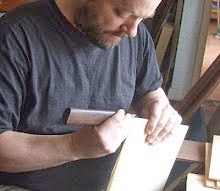
Fitting a neck is a complex and at times frustrating process. The angle of the neck in relation to the body is crucial, as an incorrectly angled neck will throw the bridge off centre. The uplift of the neck must be correct too, as this determines the bridge and saddle height. Finally, the fit and appearance of the join must be good as well. In the picture I am using a simple and wonderfully simple tool that I designed and made myself. A straight and stable baton of Douglas fir fitted with 3 screws; one at the nut, one at the twelfth fret (both set to the anticipated fingerboard thickness) and one at the bridge. It makes aligning the neck pretty much foolproof and gives me great pleasure to use.

Tuesday, 8 November 2011

In the workshop-Adams guitar


I have been meaning to post these pictures for some time now, but working out how to use the new camera and keeping up with tasks in the workshop has prevented me from doing so. These pictures are of Adam's guitar, which has a Western red cedar soundboard and Indian rosewood back and ribs. These pictures were taken some time ago; the guitar will be ready for polishing by the end of this week. The rosette is a simple but elegant one. It harks back to Torres, but its strong simplicity has a very contemporary feel to it. I make my rosettes in a jig and then inlay them whole into the soundboard. The cut you can see in the rosette allows for easier fitting and is completely hidden under the fingerboard once the instrument is complete.


Here is a picture of the finished soundboard and the back behind it. I still use a fairly traditional strutting pattern and many familiar elements can be seen in my strutting. One of my main interests at the moment is adjusting the positioning of the 3 lower bout cross bars in relation to the soundboard qualities. The positioning of the bar directly beneath the bridge is particularly crucial. I am conducting experiments on my test bed guitar to nail this down more precisely. I have been using this pattern for about 5 years and it gives me the beauty of sound that I love, with a power and dynamic range which many contemporary players require.


Here is a rare action shot! I do not use a full form to build the guitar, which I find cumbersome to use. I have a base board with a small number of locating dowels that hold the ribs in place whilst the end blocks are glued in. In this picture I am cutting the notches in the linings into which the back bars will fit. Those of you who know me well will gasp the at appearance of glasses. Years of close work have caught up with me so I now have this new bit of crucial workshop equipment.


This picture shows the linings and end block. It also shows the laminated rib construction that I use on most of my guitars. The end block is given a few coats of shellac for no other reason than I like the look of it through the soundhole. With the notches cut I am now ready to finally fit and glue the back, before moving on to the top linings and soundboard fitting.

Friday, 22 July 2011

Herman Hauser


Hauser has a special place for me as the first great guitar I held, played and examined was a guitar that Hauser made in 1935. Once, as a young student in London, I was chatting to Colin Cooper, then the editor of Classical Guitar magazine. He mentioned that Victoria Kingsley had a Hauser, and a Bouchet. I duly wrote to her, asking if I could see the guitars, to which she kindly agreed. I visited her in Hampstead one dark winters evening and she very trustingly left me alone with her instruments for as long as I wished. She also provided me with a cup of delicious Earl Grey tea, served in a delicate china cup. Sadly the light was bad, and my photographic equipment primitive. The picture above is the only one I have. I took notes and measurement, expecting a great secret to be revealed: I am still waiting for that revelation.
Below is a picture of a page of the notebook into which I made notes and measurements, and the note from Victoria Kingsley. They are resting on the template I made of this guitar, and that I still have and use in the workshop.
I regret that the guitar was strung with the oldest strings imaginable, but what I regret more is not talking more to Miss Kingsley who had led the most remarkable life, which was eventually to run to 100 years. I will always be grateful to her for her generosity and trust in allowing me to learn from this beautiful guitar.


Hauser is one of those names that in guitar making circles has gained almost mythical status. Undoubtedly one of the most copied makers of the 20th century, his guitars have been used by hugely influential players, of which Andres Segovia and Julian Bream are the most notable. The prices that his guitars fetch are massive, and many are bought by collectors rather than players.


I have recently been going through my archive of papers and photographs and taking the opportunity of throwing quite a lot of material out. The pictures in particular have provoked quite a few trains of thought; none more so than these pictures of a Herman Hauser guitar that I worked on 4 or 5 years ago. Built in 1941, this guitar is pretty representative of Hauser's output and includes his characteristic rosette, headstock and inlay. Whilst it was in the workshop I took the opportunity to take detailed measurements and from these produced a full size working drawing. There were no surprises with this guitar, and anyone who is familiar with drawings of Hauser guitars by Richard Brune and Jeff Elliot will immediately recognise the details on my drawing.

.
The 1941 guitar was a pleasure to have in the workshop. The back and ribs were Indian rosewood, a timber that I have seen on a number of Hauser's instruments. The neck was mahogany with a tight, precise V-join. The top was of good quality but had a number of previously repaired cracks. It was thicknessed to 2.5 mm, thinning to 2.2 around the periphery. It should be noted that the instrument had been refinished, although I felt that the top had not been substantially altered. And how did it sound? Well-balanced, refined, not loud (nor quiet), a deep bass register that had not become flabby...to be honest I suspect it was past its best, but it is still a fine guitar. A hugely important piece of classical guitar history but no longer a concert guitar in my opinion.


2 years ago I was walking through Central Park in New York, wondering whether I had time to fit in a visit to the Metropolitan Museum of Art that was close by. They hold a fabulous collection of guitars, including Segovia's '37 Hauser, which he described as 'the greatest guitar of our epoch'.

The more I thought about it, the more cross I became with that statement and began to see it as rather destructive. I suspect Segovia was saying more about his own involvement with this guitar than anything else but it set the seeds of a grand distortion.


I, like many others, have been brought under the indefinable spell of Hauser, and have certainly played and heard some beautiful guitars that he made. He understood the materials he was working with, and he understood the nature of the instrument he was making. However, Hauser's qualities remain elusive and one wonders sometimes how his, or any maker's status for that matter, should really be evaluated.


Friday, 25 February 2011

Satinwood guitar sets


Last week I took advantage of some early spring sunshine and drove out to Dykes luthiers Supplies in East Sussex. Dave Dyke is one of the most established tonewoods and musical instrument parts supplier in the UK, having been in operation since the early 1970's. I always enjoy going out there as he lives in a beautiful part of rural Sussex and on this occasion the landscape looked neat and full of activity. My main reason for the visit was to pick up a few bits and pieces for repair work that I had in hand; tuners, nuts and saddles and fretwire. However on a previous trip last year, I had spotted a couple of sets of really nice satinwood and had vowed to return for them. Satinwood is a lovely timber and has been used for fine furniture and decorative objects for years. Lacote used it for the backs and ribs of some of his guitars and in the early 20th century, Fransisco Simplicio used it for some of his stunningly ornate guitars and just recently some makers, including myself, have begun to favour it again.
The set pictured ( and as always it is hard to do it justice) has a lovely beeswing figure as well as the warm golden colour. I am very much looking forward to using these sets. One is already spoken for and I wouldn't be surprised if the second set goes fairly quickly as well.

Saturday, 15 January 2011

Happy New Year!

I think the fact that I have only just been able to post a Happy New Year message is pretty much indicative as to how busy the past few weeks have been, and at the moment it very much looks as though 2011 is going to proceed in a similar fashion.
Johns guitar is nearly finished and ready for polishing; pictures to follow in the coming week. Various small repairs have been taken in, completed and dispatched. Simon brought his Ramirez round on Saturday and we spent a happy half hour discussing guitars and kite surfing! I have also drawn a N. G. Ries terz guitar from the mid 19th century, and I intend to knock out a copy later this year. I am also gearing up to make a Stauffer copy with an adjustable neck, although as that is just for fun it will have to slot in between commissions. I will post more on these guitars soon.
Polishing continues: I am polishing a walnut and spruce guitar made by Max in my workshop. It's a lovely looking guitar and we are all keen to hear what it sounds like. Max takes the wonderful pictures on my main website including the one at the top of this post. This guitar has long gone from the workshop but its hard to resit showing it again! So a busy year in front of me-keep watching!