Showing posts with label James Westbrook. Show all posts

Sunday, 16 December 2012

Ries copy completed


Just before Christmas I finally completed this copy of a terz guitar by Nikolaus Georg Ries. This had been a long standing project and more can be read about it here and here. I had built this guitar for my own pleasure and education, but once strung it remained in my workshop for less than a day before being enthusiastically purchased. I had a lot of fun building the guitar and learnt much from it. I was lucky to have the original in the workshop throughout and so was able to make a very accurate copy. The picture above shows the original in the process of being restored, my copy, and a full sized modern classical guitar for scale. This small guitar is tuned a third higher than a standard guitar, has a scale length of 574 mm, and has a bright, lively sound. For such a small guitar it has surprising volume and is great fun to play.


Making replica guitars presents a number of interesting challenges. It becomes clear when you first look at the original terz guitar that it was built quickly and economically. The quality of the timber is good and is all European; maple for the back and ribs, spruce front and the neck, fingerboard and bridge are stained or polished to look like ebony. The decoration in minimal, with simple purflings on the top but the back is completely unbound. Inside the original, the workmanship was confident and skilled but not refined, and tool marks were visible on the struts and the inside of the top. This was a functional working instrument that would have been produced quickly and cheaply. My guess is that the Ries workshop could assemble one of these instruments in a few days. I originally intended to make this guitar quickly but inevitably other commisions took priority. My only significant departure from the original was the use of a 2 piece, rather than a single piece, maple back. Also, as the original bridge was missing, I had to take specifications for the bridge for my instrument from other sources.


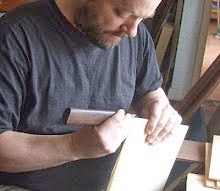
Not the best picture of me I'm afraid (this is as close as I get to smiling for the camera) but it does show the petite size of the guitar. This picture was taken on a bitingly cold morning; the instrument left the workshop a few hours later and I felt bereft. I must make another when I have time...


The original guitar is being carefully restored by 19th century guitar expert, James Westbrook and in the past week he has completed the work on it and strung it to tension. The restored original is shown below. I was keen to play this guitar and to see how it compared to my copy. As mentioned, the small size of this guitar and the shorter scale length contributes much to the sound, and I was struck between the similarities of my new copy, and the original.


Thursday, 30 December 2010

David Rubio, Luthier


Recently, thanks to my friend James Westbrook, I had the opportunity of examining the log book from the archive material of extraordinary English luthier, David Rubio. The rather grand front of this book is shown above, complete with an unused Rubio rossette. Log book is perhaps not the right title for this document; it is part diary, part note book, part order book. Initially, when I opened this, I was hoping for workbench notes on instruments made or examined, but there was little of this. However, this proved to be a document that inspired, educated and moved me.

David Rubio started building guitars in New York in the early 1960s. A career in medicine had been the intention but colour blindness prevented this. Rubio's skill as a flamenco guitarist brought him into contact with guitars and guitarists, and it was almost inevitable that his interest in making musical instruments grew.

Looking at the beginning of this log book you can see the origins of Rubio's business. Most of his clients at this time were local to New York, perhaps familiar faces to Rubio from his days as a professional guitaris? He also took in repairs; Domingo Esteso is mentioned, and he must have learned much from these instruments. It is quite apparent that David Rubio's reputation and workload gathered pace rapidly. The pages of this book fill as the 1960s progress and some familiar names start to appear.


One of the most important names to appear in these pages is that of Julian Bream. The support of Bream must have been important to Rubio, but Bream was also very lucky to find a maker of Rubio's caliber, and to have guitars and lutes made for him. It is easy to imagine Rubio and Bream at the Greenwich Village workshop, discussing instruments and pinning down the details of Bream's next commission. The image is added to by a small technical sketch on one of the pages. It is a detail of a lute by Thomas Goff, and it seems likely that this was Bream's lute that Goff made for him.


Tucked into the log book are some random documents such as a business card, pictured above, with the Duns Tew address. There are some receipts for wood from Andreas Gleissner (my first batch of 50 spruce tops came from Gleissner) and a fabulous letter from an American client arranging to pick up a guitar from Rubio after his relocation to England. The happy recipient of the guitar insists that he will take David and his wife for a celebratory meal at a restaurant of their choice.


There is much to be enjoyed in this notebook, and it really has fired me up in all sorts of ways. Last year I heard Paul Fischer at the Cordefactum guitar festival in Belgium, lecturing on Rubio and this notebook adds to my knowledge of a guitar maker I have long admired. One thing that is clear is that Rubio was an incredibly hard worker and I have heard that often meals would be taken into the workshop and eaten at the bench while he worked. His passionate curiosity turned him towards early instruments, violins and keyboard instruments. He really had extraordinary talents.

Above all else, this log tells part of the story of a man's passion, of his career and his contribution to musical instrument making. I had the good fortune to meet David Rubio, albeit briefly. I was a student at the London Collage of Furniture and on one occasion David and his wife visited the musical instrument making department and had a look around the workshop. I seem to remember that he recommended we should buy a rather expensive German vice, although that was beyond our reach at that time. Since then I have worked on a number of Rubio guitars and my opinion of him grows - a man of real substance and a fine luthier.

Wednesday, 24 February 2010

Vincente Arias
This guitar came in with little warning but rarely am I so enamoured with a guitar as with this one. Vincente Arias was working in Spain in the last part of the the 19th century and into the first decade of the 20th. They are rare finds indeed and this one is in fantastic original condition, even down to the brass frets. The rosewood is prime Brazilian and I love the polish on the soundboard - so fine and clear. Built so lightly it seems to tremble as you pick it up and work on it.
I have not had to do much to this instrument. The bridge had lifted over time and so was carefully removed, cleaned and then re-glued with hot hide glue. At some point the guitar had been dropped and this had put a large split in the bass rib. This has now been cleaned and glued. You can see some damage to the tentelones and glue from some previous repairs.


Simple, but very beautiful to the eye and that, as it transpires, is how it sounds too. Last night I returned it to Jim and had the pleasure of hearing accomplished guitarist, Adrian Rius, play this guitar. Adrian was returning FE 18 after the Tarrega exhibition in Spain, so Jim and Ging provided a fabulous evening of food and music. Nice to see Pablo Requena there too. Not only is Pablo a fine guitar maker but he can sing as well! Great stuff. And so the evening ended with Adrian playing 2 Torres guitars and the Arias. The guitars sounded better than ever and the playing was delicate and haunting. I left clutching the remains of a bottle of 1970 Fonseca's port (thank you Jim) and with Tarrega and Torres (and Arias) ringing in my ears.