Saturday, 26 October 2013

Paul Fischer

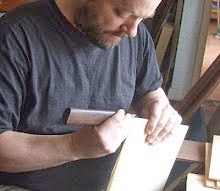
Open day at the London College of Furniture 1986.
(from left to right, Lily Mairants, Terry Pamplin, Marian Romanillos, John Mills, Jose Romanillos, Ivor Mairants, Paul Fischer and Herbert Schwarz)


I have recently heard that Paul Fischer has retired from guitar making after a long and successful career as an internationally acclaimed guitar maker. It seems strange to think that Paul, who has been such a force in UK guitar making will no longer be at the workbench, but I hope he may be able to contribute some of his expertise and enthusiasm in other ways.

I first met Paul in the mid 80's when I was an aspiring guitar making student at the London College of Furniture. Paul made several visits to the college and students found it very encouraging to have his support and encouragement. I remember attending a presentation of his research into alternative south American timbers. Paul had made 8 guitars, one with Brazilian rosewood for the back and ribs; the other 7 using timber that Paul had identified as being suitable alternatives. John Mills played on each guitar (from behind a screen) and a panel was asked to pass judgement on the tonal merits of each one. The exercise was a thought provoking one and Paul's careful research and enthusiasm was inspiring.

Paul started making guitars in what now seems like a different age. If you wanted a good guitar, you would have to go to Spain, or at least, go to one of the few dealers who imported Spanish guitars. Paul can be seen as one of the pioneers of modern English guitar making and did much to promote the craft.
Much to my surprise, I find that I have never played one of Paul's guitars, except  for a rather fine David Rubio guitar, stamped 'PF' but I'm sure I will rectify that one day. In the meantime I wish Paul a long and happy retirement.

Monday, 12 August 2013

Long time no blog....


Well, its been a while, but in my defence I have been rather busy....
I am just packing two guitars to go to America and a third guitar (that's the rosette above) has just arrived safely in Beijing. Four weeks ago saw 2 guitars off to Japan. I've run out of packing materials and now I just want to get on with making guitars and enjoying the summer with my family.

Back in May I had Mike in the workshop for four weeks, making his first guitar. These intensive guitar making courses are great fun but hard work for all concerned. Mike had spent his career in an office and wanted to branch out into something more creative and guitar making appealed to him. He started from scratch with no woodworking experience and at the end of the four weeks had a completed playing instrument. I think he could scarcely believe it. I love watching makers string up their first instrument as the thrill and excitement is all too evident.

Friday, 19 April 2013

Congratulations to Adam Larison.


I received an exciting email from Adam Larison this week, telling me that he had just won first prize in the Great Lakes International Guitar Competition in America. Adam is a fine young player and is pictured above just prior to the final round of the competition. As a maker, I am always thrilled to hear my instruments being played so well and it is great to have a gifted player like Adam presenting my guitars on the concert platform. Adam has a fine and accomplished tone and great musicality; I am very proud that he has chosen one of my guitars for his main concert instrument.

Practice...


Springboard, Brighton and Hove's Performing Arts Festival, recently took place. Started in 1925 under the banner of Brighton Competitive Music Festival, and supported by Brighton Borough Council, it has a long history spanning almost a century. Today the festival is still going strong, having evolved to incorporate drama as well as music, and now involves nearly one thousand local performers. Most of these, but not all, are young people between five and twenty-five. For many years I have awarded a prize in one of the classical guitar classes and was happy to do so again this year.

The competitive element in the Springboard festival is very much in the background; it always strikes me that participation and sharing of the music is far more important. It provides a fantastic focus for a musician to prepare and practise a piece and gives them a supportive platform to perform on in front of a small audience. The adjudicator this year was guitarist and composer Gary Ryan who always gives great feedback to each of the performers - a real bonus for participants. Whenever I have attended the event I have been struck by the great sense of achievement that performers get from the experience. I hope this event continues for many years; I for one will continue to support it.

My own abilities as a musician are somewhat limited and these days I get very little time for playing. Recently however, I have thoroughly enjoyed playing my Rene Lacote copy which I recently finished. With a shorter string length and a quick response it is great fun to play, and I have been working my way through some simple pieces including  Sor, Carcassi and Guiliani. I have recently been on a family break to the West Country and had a lovely room to practise in. The acoustics were crisp and lively, and the peaceful surroundings most conclusive to playing guitar music. This guitar will leave my workshop soon but I am planning on making another which I really hope I'll be able to keep keep. Who knows, if I keep on practising I might even enter Springboard next year!

Sunday, 24 March 2013

Planes, guitars and hurricanes....


One of the most rewarding moments for me, as an instrument maker, comes when I hear one of my guitars being played well by a fine player. As makers, we sometimes become absorbed by the technical aspects of the instruments we build, so it is always good to be reminded that they need to work well in the hands of guitarists. A week or two ago, I was sent a couple of video clips by a fine American guitarist, Adam Larison. They featured a couple of recent performances he had done with a guitar I made for him last year. Watching the clips, I was excited and  thrilled by how Adam made the guitar sound and it made the stresses of the guitar's export all worthwhile.

Sending this guitar out to the US caused me a lot of sleepless nights. There was the small matter of entrusting a valuable guitar to a shipping company. Having spent many hours building the guitar, the thought of it being thrown around an airport shipping depot is painful. However well packaged (and however fully insured) the guitar is, the thought of it being damaged or destroyed is unbearable.

I dispatched the guitar with DHL, a company I have used before and have confidence in. Picked up from my doorstep, it was soon at East Midlands airport awaiting dispatch. Tracking it on the internet I was dismayed to suddenly find its progress had been halted. A quick call to DHL revealed that an HMRC code number needed to be generated. HMRC were extremely helpful and promised to put this in place, but they work and their own pace (... leaving a lot of time to imagine the worst happening to the instrument).

Eventually the consignment was released  and it was a good moment when I saw that it had arrived at the DHL facility in the US. New York was being battered by Hurricane Sandy at the time, so further delays were fully anticipated, however they did not materialise and soon the guitar was in Adam's hands.

Thankfully no harm had come to the guitar, and Adam's performances on it can be viewed here and here. The first clip is of a complete performance at the John F. Kennedy Centre for the Performing Arts in Washington. Adam Larison plays at about 11.30 minutes into the video, but please listen to the other performances too, they are well worth hearing.  


Tuesday, 19 February 2013

In the workshop...


As we are well into the second month of 2013, I really thought I should present an update on some the work that is progressing on my workbench. The workshop has been a warm and attractive space to be in, and I have only made the occasional foray out into the cold and wet Sussex countryside. The picture above is of a top I have been strutting this week. This is a strutting pattern that I have been using for about 7 years and although I refine it almost constantly, I am sure that it is the pattern that I will be using for many years to come. It is essentially a reinforced fan strut pattern, but is a little more complicated to make as there is some painstaking fitting of interlocking spruce struts.


Regular readers of this blog will know of my interest in 19th century guitars and this guitar above is a recently finished copy of a guitar by Rene Lacote. I say finished; in fact it is now being polished and the bridge is yet to be made, but I call that finished! I have been able to make a very faithful replica, as I have had the original in the workshop whilst building it. I am going to write a complete post on this lovely little guitar when it is strung, so watch this space.


These 4 guitars have not really featured on this blog before, although as they are all rather pretty they may well merit a photograph or 2 when finished. They are all being polished at the moment and I am getting into quite a rhythm with my polishing. Polishing 5 guitars at once (these 4 plus the Lacote) takes up a reasonable part of the morning but as I have said before, I find it relaxing, even meditative.
And finally, the four bridges below are all matched with the four guitars above. I don't always polish bridges, sometimes preferring to finish them with an oil finish which gives them a soft, satin lustre. These bridges are being polished however and the one furthest from the camera is destined for a drop shouldered cutaway guitar, hence the slightly more contemporary design.


Sunday, 16 December 2012

Ries copy completed


Just before Christmas I finally completed this copy of a terz guitar by Nikolaus Georg Ries. This had been a long standing project and more can be read about it here and here. I had built this guitar for my own pleasure and education, but once strung it remained in my workshop for less than a day before being enthusiastically purchased. I had a lot of fun building the guitar and learnt much from it. I was lucky to have the original in the workshop throughout and so was able to make a very accurate copy. The picture above shows the original in the process of being restored, my copy, and a full sized modern classical guitar for scale. This small guitar is tuned a third higher than a standard guitar, has a scale length of 574 mm, and has a bright, lively sound. For such a small guitar it has surprising volume and is great fun to play.


Making replica guitars presents a number of interesting challenges. It becomes clear when you first look at the original terz guitar that it was built quickly and economically. The quality of the timber is good and is all European; maple for the back and ribs, spruce front and the neck, fingerboard and bridge are stained or polished to look like ebony. The decoration in minimal, with simple purflings on the top but the back is completely unbound. Inside the original, the workmanship was confident and skilled but not refined, and tool marks were visible on the struts and the inside of the top. This was a functional working instrument that would have been produced quickly and cheaply. My guess is that the Ries workshop could assemble one of these instruments in a few days. I originally intended to make this guitar quickly but inevitably other commisions took priority. My only significant departure from the original was the use of a 2 piece, rather than a single piece, maple back. Also, as the original bridge was missing, I had to take specifications for the bridge for my instrument from other sources.


Not the best picture of me I'm afraid (this is as close as I get to smiling for the camera) but it does show the petite size of the guitar. This picture was taken on a bitingly cold morning; the instrument left the workshop a few hours later and I felt bereft. I must make another when I have time...


The original guitar is being carefully restored by 19th century guitar expert, James Westbrook and in the past week he has completed the work on it and strung it to tension. The restored original is shown below. I was keen to play this guitar and to see how it compared to my copy. As mentioned, the small size of this guitar and the shorter scale length contributes much to the sound, and I was struck between the similarities of my new copy, and the original.